


Views: 0 Author: Site Editor Publish Time: 2025-11-28 Origin: Site


Centralized feeding systems (CFS) are revolutionizing plastic manufacturing. These systems improve material handling, reduce waste, and streamline operations. Unlike decentralized systems, CFS centralizes material transport, making production more efficient and cost-effective. In this guide, we'll explore how CFS enhances consistency, saves labor, and why more manufacturers are adopting this technology.
A centralized feeding system (CFS) is an automated solution designed to handle plastic raw materials in bulk. It centralizes the storage, preprocessing, metering, conveying, and control of materials, ensuring consistent and efficient production. The system integrates components such as silos for storage, dehumidifiers for moisture control, loss-in-weight scales for precise measurement, and vacuum conveyors for material transport.
CFS replaces the traditional decentralized setup, where each machine has its own hopper and dryer. In a decentralized system, materials are manually handled and transported, which often results in material waste, inconsistent quality, and higher labor costs. By centralizing the feeding process, manufacturers can eliminate these inefficiencies and improve overall production consistency.
Core Component | Function | Plastic-Specific Features |
Raw Material Storage | Stores bulk plastics (granules/powders) and regrind | Silo storage, molecular sieve dryers for moisture control |
Preprocessing Module | Conditions materials to production standards | Dehumidifiers, static mixers for even material blending |
Metering and Mixing Unit | Blends materials accurately | Loss-in-weight scales, dynamic mixers for multi-color formulas |
Conveying System | Transports materials to production machines | Vacuum and spiral conveyors for different material types |
Central Control Unit | Automates and monitors system | PLC and HMI for real-time tracking and alerts |
Centralized feeding systems offer numerous benefits, starting with eliminating material waste. By using precise metering systems, CFS reduces waste from 15% to as low as 3%, which helps manufacturers save money on raw materials. Additionally, labor costs are significantly reduced through automation—systems that once required manual handling can now operate efficiently with fewer workers. As a result, manufacturers can focus on higher-value tasks while cutting down on the number of laborers needed for material handling.
Another key benefit is consistent product quality. CFS ensures materials are transported and processed under controlled conditions, preventing contamination and moisture inconsistency. For example, when dealing with hygroscopic materials like PET, a CFS can ensure moisture levels are maintained below 0.1%, reducing defects like bubbles in extruded products. This improves the quality of end-products, making them more reliable and reducing the likelihood of product recalls or rework.
Plastic manufacturers face several challenges that a CFS can solve. Material contamination is a significant issue, particularly when raw materials are exposed to dust, moisture, or foreign particles during transport. A CFS's closed-loop design prevents these contaminants from affecting material quality.
Inconsistent drying is another problem. In traditional systems, drying cycles are often erratic, leading to defects such as sink marks or bubbles in injection-molded parts. A CFS, however, uses centralized dehumidifiers to maintain precise moisture levels, ensuring uniform drying across all materials.
Lastly, high labor costs in traditional setups are a major concern. Manual handling, frequent checks, and material adjustments lead to inefficiencies and increased operational costs. A CFS minimizes these manual processes by automating much of the material transport and monitoring, thus allowing manufacturers to operate with fewer workers while improving production speeds and consistency.
The raw material storage unit is a crucial component of a centralized feeding system (CFS). It stores bulk plastics, such as granules, powders, and regrind. Common storage options include silos, hoppers, and drying barrels. Silos are typically used for large quantities of base materials like PP, ABS, or PE, while smaller hoppers are used for additives or color masterbatches. Molecular sieve dryers are often integrated with these storage units to manage moisture levels, ensuring materials like PET or PA stay dry and prevent degradation during storage. These dryers maintain a low dew point, usually ≤-40°C, which is critical for hygroscopic plastics that easily absorb moisture.
Preprocessing modules are essential for conditioning raw materials to meet production requirements. Dehumidifiers play a vital role in controlling moisture levels for hygroscopic plastics such as PET and PA. Temperature control units are also used to maintain precise heat conditions, typically around 80–120°C, to prevent material degradation. Static mixers are another important feature, especially when working with filled plastics (e.g., CaCO3-blended PP). These mixers ensure an even distribution of materials, preventing segregation and ensuring a homogeneous blend before the material enters the next stage of production.
Accurate metering is essential for maintaining consistency in the production process. Loss-in-weight scales provide high precision when dosing materials, typically with an accuracy of ±0.2%. These scales are crucial when blending additives such as color masterbatches or flame-retardant compounds. Dynamic mixers are used for high-precision blending, ensuring a uniform dispersion of materials, which is especially important in multi-material applications where uniformity is key to product quality.
The conveying system is responsible for transporting materials from storage to production machines. Different conveying methods are employed depending on the material being handled. Vacuum conveying is typically used for granular materials like PE or PP, as it helps avoid material degradation during transport. Spiral conveyors, on the other hand, are better suited for abrasive powders like PVC. Material compatibility is crucial; for instance, stainless steel pipes are often used for corrosive materials like PVC, ensuring durability and longevity of the conveying system.
The central control unit is the brain of the CFS. It automates the entire system via a PLC (Programmable Logic Controller) and provides real-time monitoring through an HMI (Human-Machine Interface). The control unit stores multiple formulas for easy and quick product switches, which significantly reduces downtime between production runs. It also triggers fault alerts, ensuring that any issues such as pipe blockages or material shortages are promptly addressed. Additionally, the system is designed for seamless integration with existing production setups, making it easy to incorporate CFS into a factory's workflow without major disruptions.
In a centralized feeding system, raw materials such as granules, powders, and regrind are first stored in large silos or hoppers. These storage units are designed to accommodate bulk materials like PP, PVC, or PET. For materials like PA (Polyamide) that absorb moisture, dehumidification is used to ensure that the materials remain at optimal moisture levels, preventing defects in the final product. Additionally, regrind materials are often mixed with virgin materials, ensuring the right balance to meet production standards. This preprocessing ensures materials are ready for the next stage of production, minimizing waste and maximizing efficiency.
Once the materials are prepared, they are metered accurately using loss-in-weight scales. These scales provide precision to within ±0.2%, ensuring that the correct amounts of each material are used in the production process. High-speed mixers then blend the materials, including additives like color masterbatches or flame retardants. The automated blending process eliminates the chance of human error, ensuring that the mix is uniform, which is crucial for maintaining consistent product quality throughout production. This step is essential in industries where multi-material or multi-color formulations are used.
Once the materials are mixed, they are conveyed to the production machines through an automated system. Vacuum pumps pull the materials through closed pipes, ensuring that the raw materials reach the machines without contamination or degradation. Rotary distributors direct specific materials to their respective machines, such as directing ABS to injection molding machines or PVC to extrusion lines. Conveying methods are tailored for different processes such as injection molding, extrusion, and blow molding, with different pipe types and flow rates used depending on the material's properties.
The entire system is monitored in real-time via a PLC (Programmable Logic Controller) connected to an HMI (Human-Machine Interface). This allows operators to track key metrics such as material levels, dryer temperature, and machine feed rates. If an issue arises, such as a drop in material levels or an equipment malfunction, the system will trigger automated alerts. This ensures that problems are addressed immediately, preventing production delays and maintaining the flow of materials without disruption. These automated adjustments help maintain consistent performance and quality across the entire production cycle.
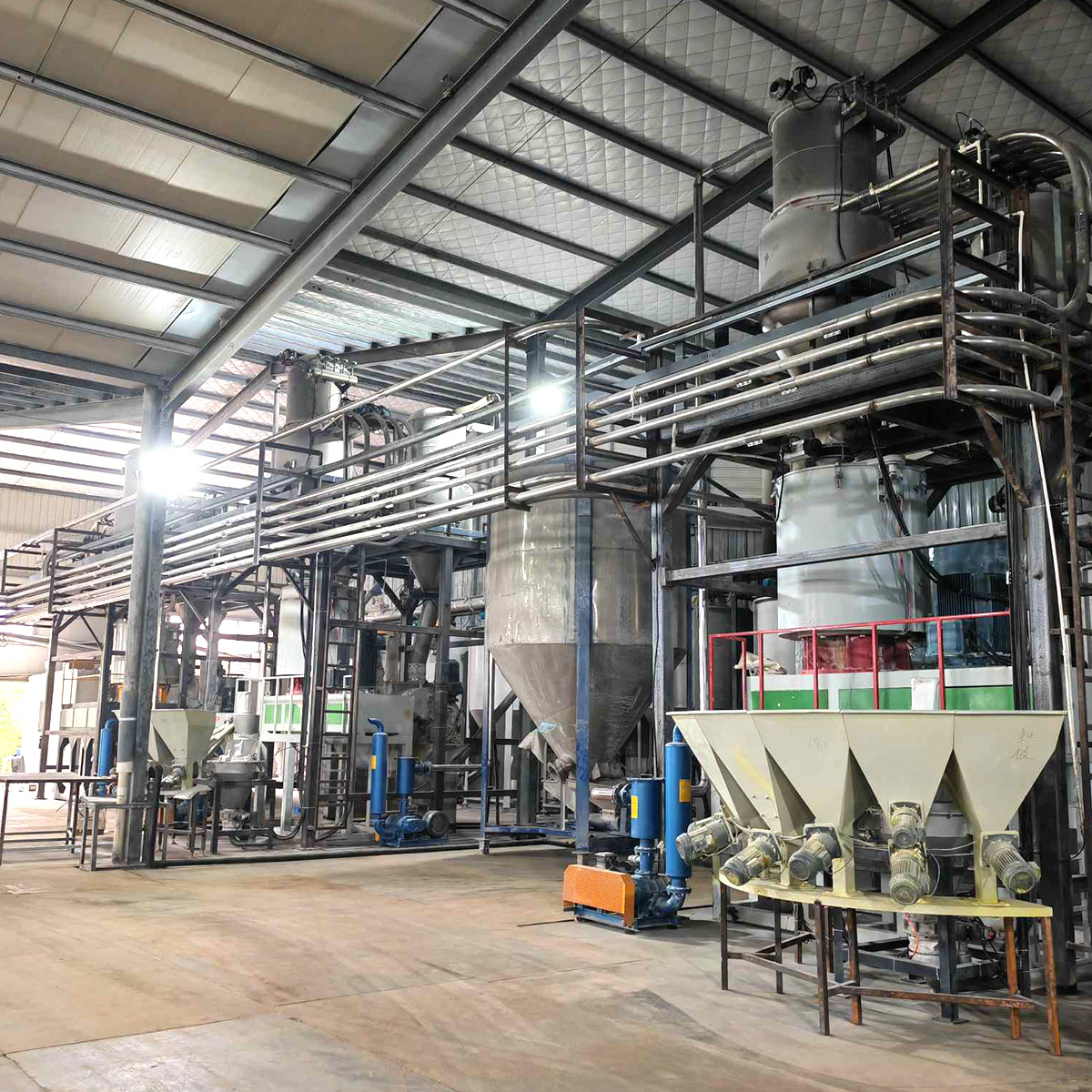
The Vacuum Negative-Pressure CFS is ideal for small-to-medium-scale injection molding workshops. This system uses low-energy consumption methods, typically ranging from 0.8–1.2 kW·h per ton of material. It is well-suited for handling granules like PP and PE, ensuring materials are transported efficiently without degrading their quality. The simplicity of its design makes it easy to implement and maintain, and it’s especially beneficial for production environments where energy savings and straightforward operations are priorities.
Positive-Pressure Dense-Phase CFS is designed for long-distance material transport. This system utilizes high-pressure methods, allowing it to convey materials over distances greater than 100 meters. It is ideal for large extrusion plants or facilities with multiple floors, where the transportation of powders like PVC and talc-filled plastics is needed. The system is robust and can handle bulk materials that require high-pressure conveying to maintain flow consistency and prevent material degradation.
Modular Micro-Feeding Systems are flexible units tailored to small-batch, custom production. These systems are particularly useful for production runs that require frequent changes, such as in medical parts manufacturing, where color switches or material changes happen regularly. The independent units allow manufacturers to adapt quickly to changing production demands, making them perfect for industries where agility and precision are critical. Modular systems also enable easy scalability, offering manufacturers the flexibility to expand their operations as needed.
For PVC extrusion processes, the PVC-Specific CFS offers corrosion-resistant components tailored to the abrasive nature of PVC. This system includes features such as spiral conveyors and hybrid conveying methods that protect the system from wear and tear while efficiently transporting materials. PVC-specific systems are designed to handle the unique challenges of transporting abrasive and corrosive materials, ensuring longevity and consistent performance. These features make it a top choice for manufacturers focused on high-quality PVC products, such as pipes and profiles.
Type of CFS | Key Features | Best Use Case |
Vacuum Negative-Pressure | Energy-efficient, simple design | Small-to-medium injection molding workshops |
Positive-Pressure Dense-Phase | High-pressure, long-distance transport | Large extrusion plants, multi-floor setups |
Modular Micro-Feeding | Flexible, small-batch production | Custom injection molding, frequent color/material switches |
PVC-Specific CFS | Corrosion-resistant, spiral/hybrid conveyors | PVC extrusion for pipes, profiles, and abrasive materials |
When selecting a Centralized Feeding System (CFS), the first step is to match the system to your specific production process. Different processes such as injection molding, extrusion, and blow molding have unique requirements that should influence your choice of system. For example, injection molding often requires a system that handles granules gently, whereas extrusion may demand a more robust system to handle powders or regrind. Additionally, the materials being used, such as moisture-sensitive plastics like PET, may require dehumidifiers or specialized drying methods, while regrind use demands a precise metering and blending system for consistent product quality.
The characteristics of the materials you use play a critical role in selecting the right system. For hygroscopic materials like PA (Polyamide) and PET, moisture control is crucial to prevent defects during production. A CFS equipped with dehumidifiers and precise temperature control is essential for maintaining material integrity. On the other hand, abrasive materials like PVC require a more durable system, especially for conveying, where spiral conveyors or stainless steel pipes might be necessary to withstand wear and tear. Choosing the appropriate metering and conveying solutions will ensure smooth material handling without compromising material quality.
The layout of your manufacturing plant also affects the type of CFS you should select. If you have a small workshop with fewer machines, a vacuum negative-pressure system may be sufficient and more cost-effective. For larger plants or multi-floor operations, a positive-pressure dense-phase system is more suitable, as it allows for long-distance material transport. Additionally, the system should offer scalability, so it can grow with your production capacity. For instance, a system that can easily accommodate additional silos or conveyors will help future-proof your operations as demand increases.
When choosing a CFS, it’s important to ensure that the system provider offers reliable after-sales support. This includes not just installation and training but also ongoing service to maintain the system's efficiency. Additionally, the system should be easily integrated with your existing production systems and MES (Manufacturing Execution Systems) to enable smooth operation. As Industry 4.0 technologies evolve, ensure that the system can adapt to future automated controls, predictive maintenance, and IoT monitoring to maximize efficiency and reduce downtime.
Step | Considerations | Key Features to Look For |
Step 1: Matching to Process | Injection molding, extrusion, blow molding | Process-specific material handling, drying, metering |
Step 2: Evaluating Material | Hygroscopic and abrasive materials | Moisture control, durable conveyors, metering precision |
Step 3: Layout & Scalability | Plant size, machine count, multi-floor operations | Scalability, long-distance transport, modular options |
Step 4: After-Sales Support | Installation, training, ongoing service | MES integration, Industry 4.0 adaptability, predictive maintenance |
Adopting a Centralized Feeding System (CFS) for plastic manufacturing offers significant advantages in terms of efficiency, cost savings, and quality control. A CFS streamlines material handling, reduces waste, and enhances production consistency. When selecting the right system, consider factors like production process, material characteristics, and workshop layout. Companies like Yifan provide robust CFS solutions that help improve operational performance while ensuring scalability and seamless integration with existing systems. Their systems are designed to optimize productivity and reduce downtime, making them a valuable investment for manufacturers.
A: A Centralized Feeding System (CFS) is an automated solution that centralizes material storage, preprocessing, metering, and conveying in plastic manufacturing. It ensures efficient material handling and consistent production quality.
A: A Centralized Feeding System streamlines material transport, reducing manual handling, minimizing waste, and ensuring consistent quality, which improves overall production efficiency.
A: Centralized Feeding Systems offer greater efficiency, reduce labor costs, prevent contamination, and ensure precise material metering, unlike traditional decentralized systems.
A: Centralized Feeding Systems handle a wide range of materials, including granules, powders, and regrind. Specific systems may include features like dehumidifiers for moisture-sensitive plastics.


