


Views: 0 Author: Site Editor Publish Time: 2026-08-14 Origin: Site


The hidden costs of manual resin handling in plastics manufacturing often go unnoticed until they severely impact the bottom line. Material spillage, cross-contamination, and inconsistent drying times lead to high scrap rates and inefficient warehouse footprints. As plastic factories scale injection molding, extrusion, or blow molding operations, relying on manual labor and forklifts for material transport creates severe production bottlenecks. This manual approach compromises floor safety and makes precise recipe traceability and inventory control nearly impossible to maintain at scale.
Transitioning to a fully integrated automatic material handling system shifts the facility from reactive, labor-intensive material feeding to a highly controlled, data-driven process. By automating the flow of raw polymers, facilities eliminate human error from the dosing equation and ensure continuous machine operation. This guide breaks down system architectures, technical evaluation criteria, and implementation realities for decision-makers automating everything from raw bulk storage to machine-side dosing.
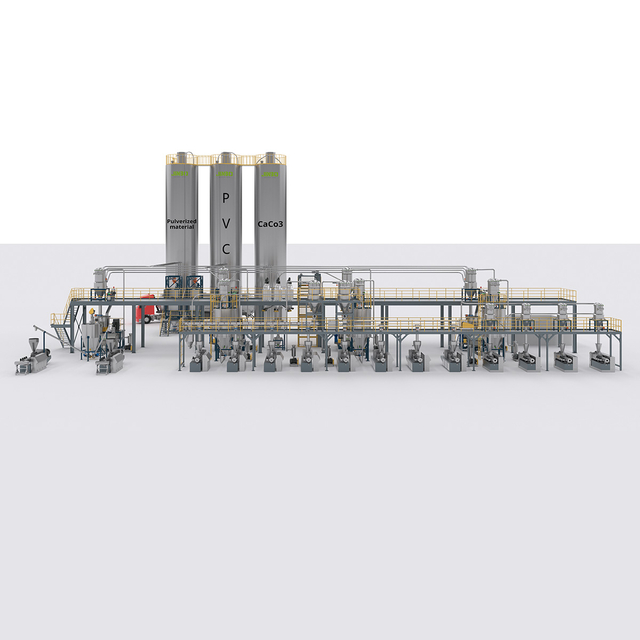
Throughput & Consistency: An automatic material handling system standardizes resin delivery, ensuring machines are never starved and material-to-product ratios remain strictly controlled.
Comprehensive Inventory Control: Modern systems go beyond pneumatic conveying, integrating warehouse management and automated transport to protect, store, and control materials with pinpoint accuracy.
Risk Reduction: Centralized conveying, automated dosing, and mobile robotics eliminate cross-contamination risks and drastically reduce dangerous forklift traffic on the production floor.
Architecture Trade-offs: Choosing between centralized and decentralized (machine-side) systems depends heavily on facility layout, material variety (virgin, regrind, additives), and future scalability needs.
ROI: While upfront capital expenditure is significant, ROI is typically realized within 18–24 months through reduced labor, minimized resin waste, optimized warehouse space, and lower energy consumption.
Table of Contents
Hygroscopic resins like polycarbonate (PC), nylon (PA), and polyethylene terephthalate (PET) act like sponges in a factory environment. When operators open a 55-pound bag or a gaylord in a humid facility, the resin immediately absorbs ambient moisture. This moisture turns to steam inside the injection barrel, causing splay, voids, and brittle parts that fail quality control. A closed-loop automatic material handling system uses dry air to convey pellets directly from the dryer to the feed throat, completely isolating the material from factory air.
We utilize desiccant wheel dryers that maintain a strict -40°F dew point. The system monitors this continuously via inline sensors. If the dew point spikes due to a saturated desiccant bed, the system triggers an alarm and halts conveying before wet material reaches the mold. This automated conditioning ensures that the structural integrity of the final plastic component meets exact engineering specifications every single cycle.
Manual material handling requires operators to drive forklifts, move gaylords to the press, and use vacuum wands to suck up pellets. In many facilities, personnel still climb ladders to manually dump bags of masterbatch into machine hoppers. This process is slow, dangerous, and a massive waste of manpower. By installing an automated conveying network, you pipe the material directly from the silo or central material room to the machine throat.
The operators who previously spent their shifts sweeping up spilled pellets and swapping empty gaylords can be reallocated to high-value tasks. They focus on optimizing injection speeds, checking part tolerances, and performing preventative mold maintenance. Furthermore, eliminating the constant movement of bulk material drops forklift traffic on the production floor by up to 80%, which immediately reduces OSHA recordable incidents and creates a safer working environment.
Facilities molding medical devices or automotive safety components must maintain strict lot traceability. You have to prove exactly which batch of resin went into which part on which day to comply with ISO 13485 or IATF 16949 standards. Manual logs written on clipboards get lost, misread, or faked. An automated system logs every pound of material digitally. It ties the silo lot number directly to the specific machine and time stamp, storing the data in the central server.
We also deploy gravimetric blenders at the machine throat to control the recipe. These units weigh the virgin resin, the regrind, and the colorant down to a fraction of a gram using highly sensitive load cells. You never over-color a part, and you never exceed your allowable regrind percentage. If the bulk density of the regrind changes mid-run, the blender automatically adjusts the auger speed to keep the weight ratio perfect.
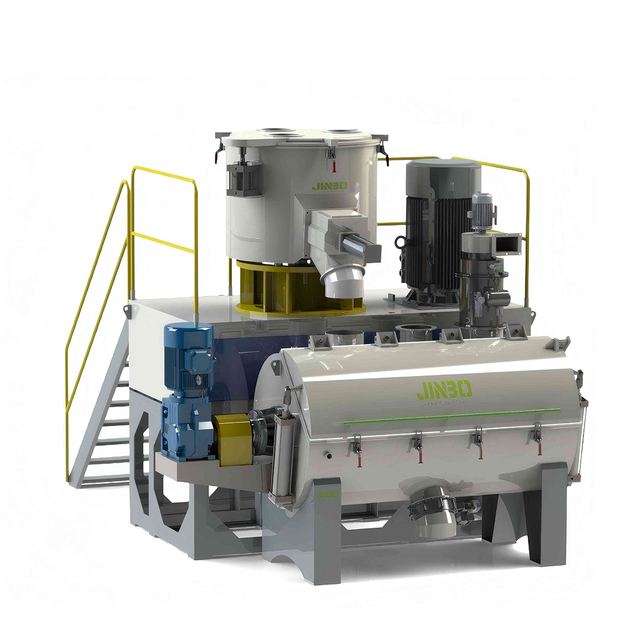
If a facility consumes more than a million pounds of a specific resin annually, welded aluminum silos installed outside the plant are standard. For smaller batches or specialty engineering resins, indoor surge bins fed by bag dump stations are utilized. We are currently seeing a massive shift toward robotic bag emptiers in mid-volume facilities. A pallet of 25kg bags rolls into the cell, a 3D vision camera locates the bags, and a robotic arm picks them up, slices them, and dumps the contents into the hopper.
This robotic integration captures the dust via an integrated vacuum hood and sends the empty bag to a baler automatically. Continuous level sensors inside the silos and surge bins transmit real-time inventory data to the central control system. When stock drops below a defined threshold, the system triggers an automated reordering alert to the purchasing department.
You have two primary methods to move plastic pellets through a pipe: vacuum (pulling) and pressure (pushing). Vacuum conveying is the standard for moving pellets from a central material room to the molding machines. If a pipe fitting leaks, the system sucks air in; it does not blow plastic dust out onto the clean factory floor. Pressure systems are reserved for moving massive volumes of material over long distances, such as unloading a railcar into a silo.
Central manifold stations serve as the routing hubs for these conveying lines. Think of them as automated switchboards. Diverter valves open and close based on Programmable Logic Controller (PLC) commands. This automated source-to-destination routing ensures you cannot accidentally send black ABS to a machine running clear acrylic, preventing catastrophic tool damage and hours of barrel purging.
Pneumatic pipes are highly efficient for high-volume resins, but they are impractical for custom colorants or specialty additives used only once a month. You do not want to dedicate a permanent pipe to a material that rarely runs. This is where Autonomous Mobile Robots (AMRs) integrate into the automatic material handling system. When a machine signals it needs a specific masterbatch, the AMR navigates to the warehouse, picks up the drum, and delivers it directly to the press.
We also deploy AMRs to close the loop on the production floor. Once parts are ejected and boxed at the machine side, the robot transports the finished goods directly to the warehouse or assembly area. They navigate dynamically around factory obstacles and human workers, keeping the aisles clear of heavy industrial vehicles.
Central drying consolidates the conditioning process by placing one massive hopper in a dedicated material room. You can dry 5,000 pounds of ABS at once and pipe it to ten different machines running the same job. This maximizes energy efficiency and saves valuable floor space around the presses. Machine-side drying places a smaller dryer directly on the feed throat. This setup is utilized when every machine runs a different material and requires maximum flexibility.
For specific polymers like PET, standard drying is insufficient. Amorphous PET will turn into a solid brick if you apply high heat immediately. We integrate automated crystallizers into the workflow. The crystallizer agitates the pellets mechanically while heating them slowly until they transition into a crystalline state. Only then do they drop into the main drying circuit for final moisture removal.
Gravimetric blenders operate on a loss-in-weight principle. They weigh each ingredient before dropping it into the mixing chamber. This technology provides high-accuracy recipe management and automatically compensates for variations in material bulk density. Gravimetric dosing is mandatory if you run regrind or expensive additives where precision directly impacts profitability.
Volumetric feeders dose materials based on the volume displaced by a rotating auger. They assume the material always weighs the same per rotation. While less precise than gravimetric systems, volumetric feeders are highly effective for stable, continuous extrusion processes where the bulk density of the virgin pellets remains strictly consistent.
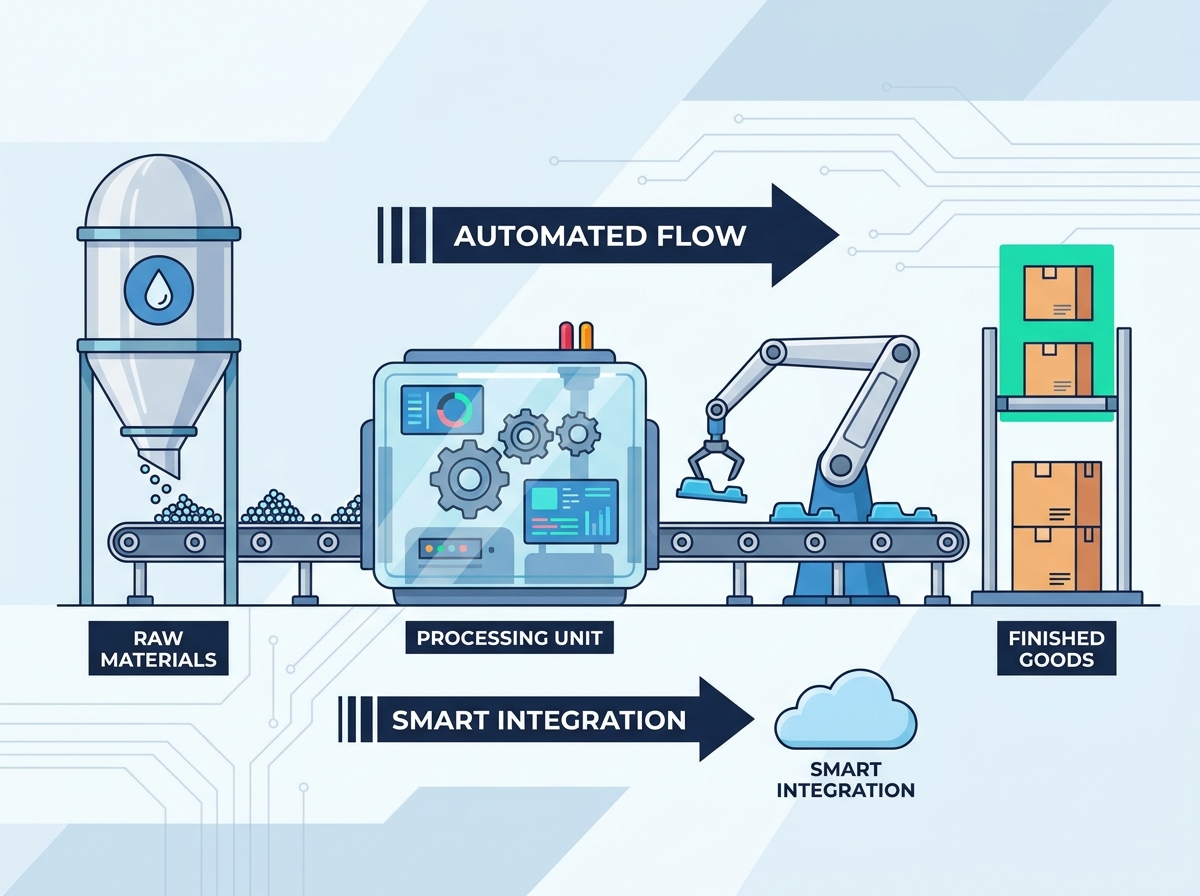
Designing an effective conveying network requires precise mathematical modeling of facility throughput. Engineers calculate the maximum pounds-per-hour (PPH) requirements across all machines running simultaneously. If you have 20 machines pulling 100 pounds an hour, the system must reliably move 2,000 PPH. This aggregate data dictates the sizing of positive displacement blowers, the capacity of central receivers, and the diameter of the conveying pipes (typically ranging from 1.5-inch to 4-inch OD).
Distance constraints dictate pump horsepower. Moving dense materials 500 feet horizontally and 30 feet vertically introduces severe pressure drops in the pneumatic lines. Every 90-degree elbow adds the equivalent of 20 feet of straight pipe resistance. If engineers undersize the pump, the machines starve. If they oversize it, the facility wastes capital and electrical power.
The flowability and abrasiveness of the specific polymers dictate the physical hardware required. Standard polyolefins like polyethylene are relatively easy to convey through standard aluminum piping. However, glass-filled nylon acts like sandpaper. If you shoot it through standard pipe, it will wear a hole through the elbows in three months. For abrasive compounds, we specify ceramic-backed elbows or glass-lined straight pipes to prevent blowouts.
Dusty regrind requires oversized cyclone filtration systems at the pump to catch the dust before it destroys the blower lobes. Lightweight flakes from recycled bottles tend to bridge or rat-hole in standard hoppers, requiring mechanical agitators to keep the material flowing. Highly static materials demand specialized grounding techniques and static-elimination equipment to prevent pellets from clinging to the walls of the receivers.
The PLC acts as the brain of the automated handling network. It monitors the vacuum receivers on the molding machines. When a receiver signals it is empty, the PLC opens a manifold valve, turns on the pump, and pulls material. A robust Supervisory Control and Data Acquisition (SCADA) system provides operators with a visual dashboard of the entire plant, displaying material levels, vacuum pressures, and active conveying routes.
We integrate this control architecture directly with Warehouse Management Systems (WMS). When the outdoor silo drops below 20% capacity, the WMS automatically emails the resin supplier to dispatch a bulk truck. Utilizing open communication protocols like OPC UA and MQTT ensures seamless data exchange between the material handling hardware, the WMS, and the overarching ERP platforms.
Facility layout and production style dictate whether a centralized or decentralized architecture makes the most operational sense. Centralized systems consolidate pumps, filters, and dryers in a dedicated material room. This keeps heat and noise away from the production floor and is highly scalable for high-volume runs. Decentralized systems place individual loaders and dryers directly at each machine, offering unmatched flexibility for custom molders that change molds and materials daily.
System Architecture Comparison
Feature | Centralized Architecture | Decentralized (Machine-Side) Architecture |
|---|---|---|
Production Suitability | High volume, low material variety | High mix, frequent material changeovers |
Maintenance Footprint | Consolidated in a single material room | Spread across multiple individual machines |
Floor Space Impact | Frees up space around the molding machines | Requires physical footprint at every press |
Scalability | Highly scalable by adding manifold ports | Requires purchasing standalone units per machine |
Energy Efficiency | High efficiency through shared vacuum pumps | Variable, depends on individual unit usage |
Evaluating the financial impact of automation requires looking at immediate operational improvements. You justify the system by calculating the reduction in scrap rates. If a facility currently scraps 4% of its parts due to moisture or bad color mixing, and the automated system drops that to 0.5%, the material savings are massive. Labor reallocation also plays a major role; operators previously tasked with moving bags now manage multiple automated cells, increasing the revenue generated per employee.
Facilities must budget for the lifecycle management of wear parts to maintain these operational savings. Vacuum pump filters, flexible hoses at the manifold, diverter valve seals, and robotic end-of-arm tooling require scheduled replacement. Establishing a predictive maintenance routine ensures that these wear parts are swapped out before they fail and cause unexpected downtime.
Pneumatic conveying systems are inherently energy-intensive. Older systems utilized fixed-speed blowers that ran at 60Hz all day, regardless of the actual conveying demand. We now specify systems equipped with Variable Frequency Drive (VFD) vacuum pumps. If the system is only feeding two machines on a weekend shift, the VFD slows the pump down to 20Hz, slashing electrical power consumption.
We also use VFDs to control pellet velocity. You want the pellets moving just fast enough to stay suspended in the air stream. If they move too fast, they shatter on impact with the pipe walls, creating dust that clogs filters. By utilizing smart controls to dial in the exact conveying velocity required for each specific resin, facilities minimize energy draw and drastically reduce internal pipe wear.
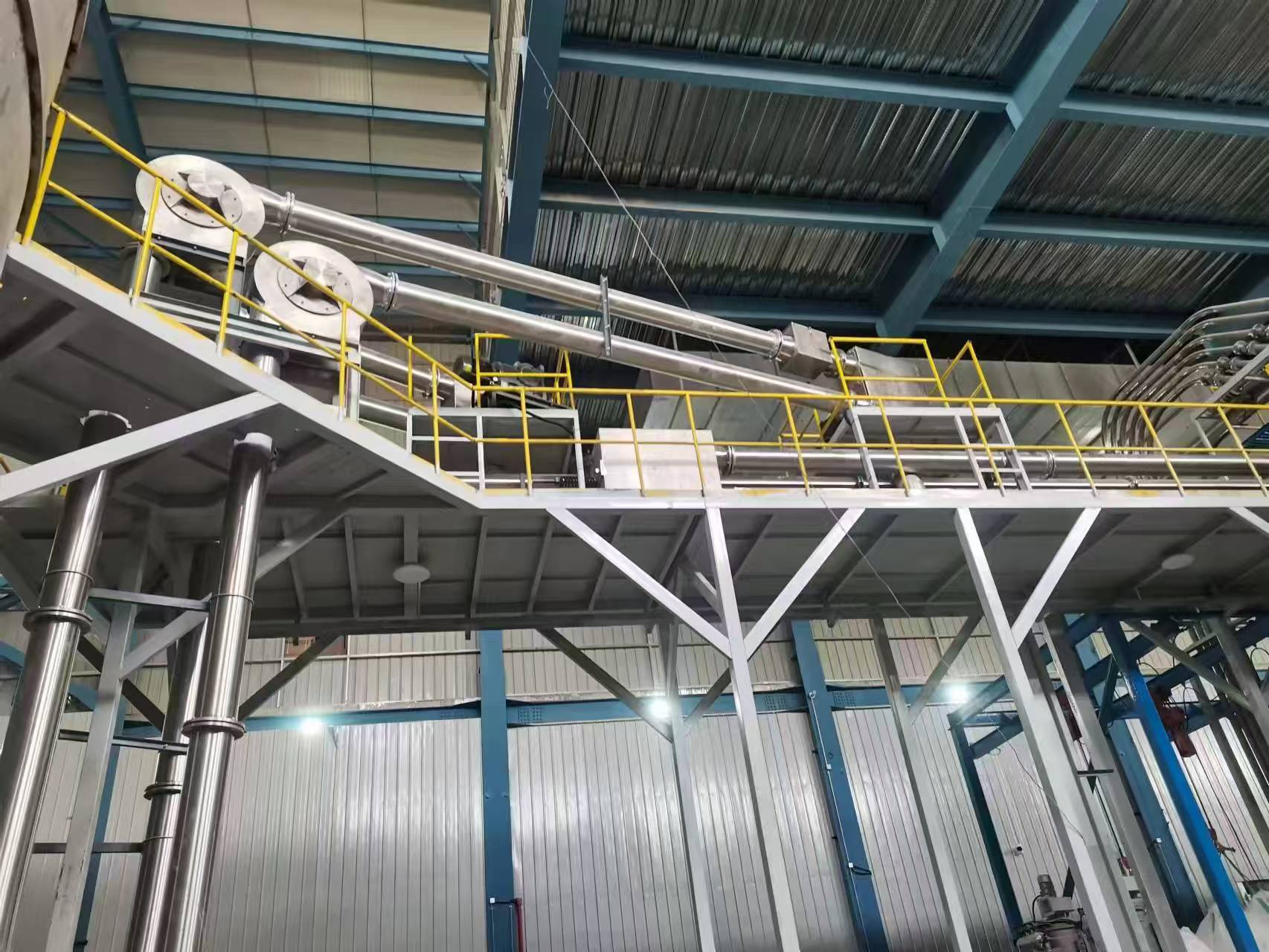
Installing a comprehensive material handling network in an active factory presents significant logistical challenges. Shutting down production for a month is never an option. We execute phased rollouts. Integrators install the overhead pipes, the central manifold, and the main storage silos while the plant runs normally and operators continue manual loading. Once the infrastructure is ready, we switch over one machine at a time during scheduled weekend maintenance windows.
Accurate facility mapping prevents installation delays. Relying on outdated facility blueprints often leads to pipe routing conflicts with existing HVAC ducts or electrical trays. We utilize 3D laser scanning prior to installation to create a millimeter-accurate digital twin of the factory ceiling and floor. This allows engineers to map out exact piping routes and AMR navigation paths virtually, ensuring the physical installation proceeds without structural interference.
Physical facility constraints dictate how and where materials flow. Overhead clearance is a primary concern; conveying lines must remain accessible for maintenance but high enough to clear forklifts and overhead cranes. Engineers must route pneumatic lines away from high-heat zones, such as barrel heaters or curing ovens. If a pipe gets too hot, the pellets melt inside and cause a massive plug that takes hours to clear.
The biggest issue in pipe routing is the generation of "angel hair." When soft pellets like polypropylene skid around a smooth aluminum elbow, friction melts the outside of the pellet. It leaves a long, thin string of plastic on the pipe wall. Eventually, these strings break loose and clog the machine throat. We prevent this by specifying shot-peened or internally roughened stainless steel pipes. The textured surface forces the pellets to tumble rather than skid, entirely preventing angel hair formation.
The most advanced automation hardware will fail if the factory workforce does not adopt it. Operators will fight the system if they do not understand it. You must communicate that the system is designed to remove the physical strain of their jobs, not to replace them. Involving key floor personnel early in the design phase builds ownership and eases the transition.
Developing clear, highly visual standard operating procedures (SOPs) is the final step in successful implementation. Operators need hands-on training for clearing plugged lines, cleaning central dust filters, safe system purging during material changeovers, and calibrating load cells on the blenders. We hang visual SOPs directly on the manifold stations so operators know exactly which valve to check when an alarm triggers.
Conduct a facility-wide audit of current material waste, warehouse inefficiencies, and labor hours dedicated to manual resin handling.
Calculate peak throughput requirements by aggregating the maximum pounds-per-hour consumption across all active molding machines.
Map out physical facility constraints, documenting ceiling heights, structural load capacities, and available floor space for centralized equipment.
Request engineering consultations and 3D facility scans from shortlisted automation integrators to visualize proposed pipe routes and manifold placements.
With 20 years of industry experience, Zhangjiagang Yifan Machinery Co., Ltd. integrates R&D, manufacturing, sales, and service, focusing on automatic mixing and feeding systems, pneumatic conveying, weighing and metering equipment, and intelligent material conveying solutions. Its equipment serves customers in more than 60 countries, giving the company an established engineering and manufacturing background for plastics manufacturers planning centralized and automated material handling systems.
A: Most plastic manufacturing facilities realize a return on investment within 18 to 24 months. This rapid timeline is driven by the immediate reduction in resin waste, the elimination of scrapped parts due to moisture or contamination, and the reallocation of manual labor to higher-value production tasks.
A: Yes. Advanced systems utilize gravimetric or volumetric blenders at the machine throat to precisely mix virgin resin, regrind, and color masterbatch. The control system monitors the exact ratios, ensuring that regrind is continuously consumed without exceeding the structural limits of the final molded part.
A: Centralized systems consolidate pumps, dryers, and filters in a single location, piping material out to multiple machines. This is highly efficient for high-volume runs. Machine-side handling places individual loaders and dryers directly on each press, offering maximum flexibility for custom molders with frequent material changeovers.
A: Autonomous Mobile Robots (AMRs) and Automated Guided Vehicles (AGVs) transport materials that are not suitable for pneumatic piping. They move gaylords of specialty resins to specific machines and transport finished molded parts from the press to the warehouse, fully eliminating the need for manual forklift traffic.
A: Pneumatic conveying moves plastic pellets through completely sealed pipelines. By utilizing a closed-loop vacuum or pressure system, the resin is never exposed to ambient factory air, dust, or moisture. Automated diverter valves also ensure materials are routed correctly, preventing accidental mixing of different polymers.
A: Routine maintenance primarily involves monitoring and replacing wear parts. Technicians must regularly clean or replace pump filters, inspect flexible hoses for abrasion, check diverter valve seals, and empty dust collection bins. Establishing a predictive maintenance schedule prevents unexpected vacuum drops and system clogs.
A: Angel hair occurs when soft plastic pellets skid against the smooth inner walls of conveying pipes. The friction melts the pellet surface, creating long, stringy strands that clog the system. Automation engineers prevent this by specifying shot-peened or textured pipes that force the pellets to tumble rather than skid.


