


Views: 0 Author: Site Editor Publish Time: 2026-08-14 Origin: Site


Fugitive dust in plastic processing facilities creates compounding costs that directly impact operational efficiency. Product loss and cross-contamination ruin batches and hurt yield. More critically, airborne polymer fines introduce severe combustible dust hazards that threaten facility safety. The physics of handling plastic resins inherently generates particulate matter. High-velocity pneumatic conveying, pipeline friction, and fragile regrind materials shatter and smear during transit. This mechanical degradation creates microscopic fines, tangled "angel hair," and long plastic streamers that clog equipment.
You must shift from reactive housekeeping to proactive, engineered solutions. Relying on manual cleaning leaves your plant vulnerable to safety violations and equipment failure. Establishing a systematic approach helps you evaluate system retrofits, point-of-use extraction, and process optimization. This methodology forms the foundation for effective plastic material dust control. By addressing the root causes of material degradation, you protect your workforce and maintain product purity.
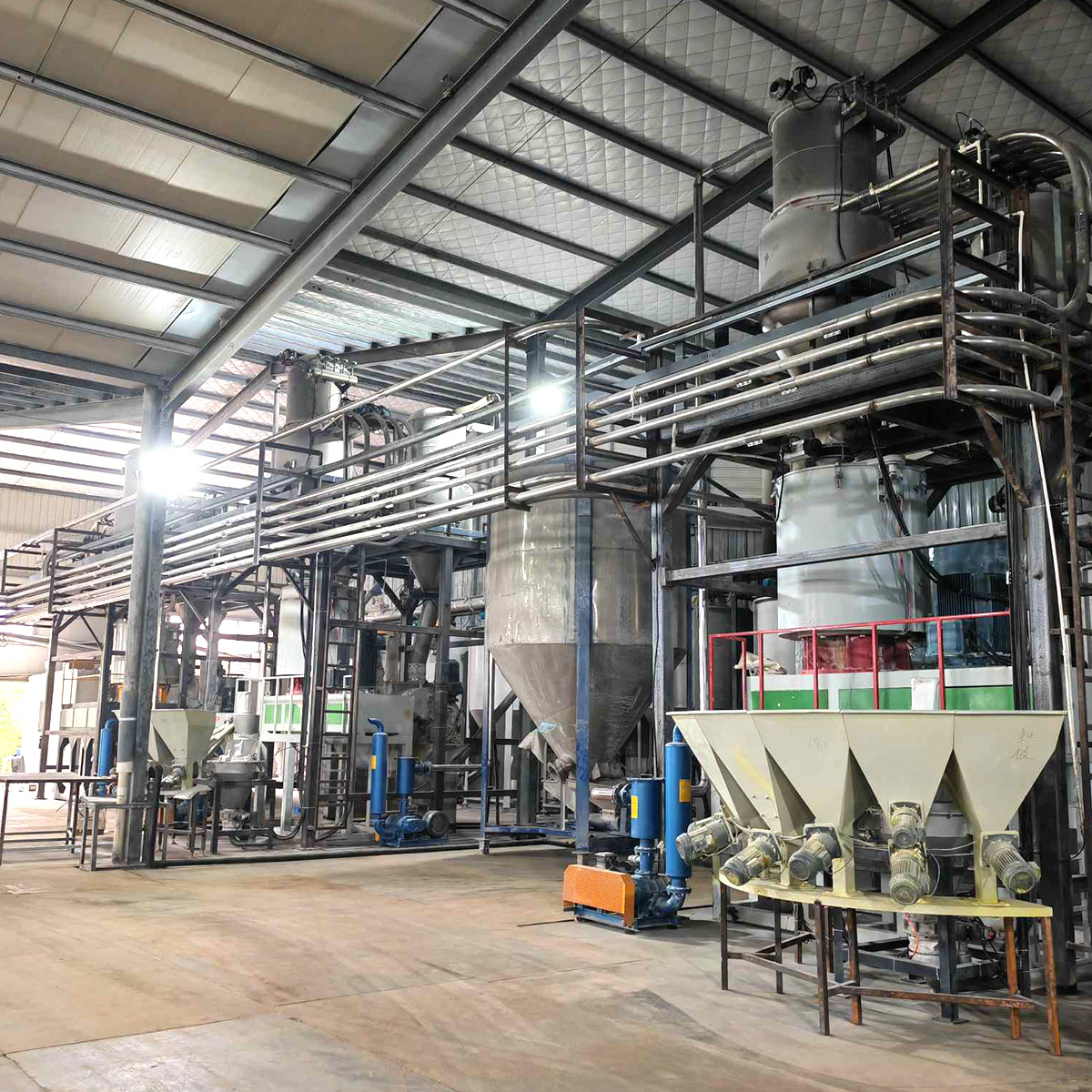
Effective mitigation requires a hybrid, systematic approach: preventing degradation at the source (velocity control) and capturing unavoidable fines (active extraction).
Generic bulk-handling solutions (like moisture suppression) are often incompatible with hygroscopic plastic resins; solutions must be dry, mechanical, and pneumatic.
System design choices—specifically elbow geometry, piping surface treatments, and phase density—are the primary levers for reducing frictional dust generation.
Compliance with NFPA 652 and OSHA combustible dust regulations is non-negotiable and dictates the selection of filtration and isolation equipment.
Table of Contents
Pneumatic conveying velocities directly dictate the rate of material degradation. When plastic pellets travel too fast through a pipeline, they slam into pipe walls and shatter upon impact. This high-speed collision creates microscopic dust particles that suspend easily in the air. Engineers must carefully calculate the terminal velocity of the specific resin being conveyed. Exceeding this velocity threshold guarantees excessive attrition and fine generation. In many older systems, blowers are oversized, pushing material at 5,000 feet per minute when 3,500 feet per minute would suffice. That excess speed translates directly into shattered pellets.
Friction generates intense heat during transit. Pellets sliding against smooth metal pipe walls experience localized melting due to this friction. The melted polymer smears across the interior surface of the pipe, forming thin strands known as "angel hair" and streamers. These strands eventually break loose, tangle together, and block diverter valves or extruder feed throats. Controlling the speed and the surface friction is the only way to stop this thermal degradation. You cannot filter out angel hair once it forms a bird's nest inside a rotary valve; you have to prevent it from forming in the first place.
Different forms of plastic behave differently inside a conveying system. Virgin pellets primarily generate impact dust. They possess a uniform shape but fracture when hitting elbows, diverter valves, or silo targets at high speeds. The dust generated from virgin pellets is usually fine and highly concentrated at impact zones. Because they are relatively uniform, predicting their flow behavior and saltation velocity is straightforward.
Powders present an inherent fugitive dust risk from the moment they enter the facility. Materials like PVC powder or compounding additives easily become airborne during any transfer, mixing, or blending operation. Powders require strict containment because they do not need high velocity to create a dust cloud; ambient air currents are enough to disperse them. Handling powders demands tight seals and negative pressure environments.
Regrind materials introduce the highest level of complexity. Regrind has inconsistent geometry, sharp edges, and varying densities. This leads to high attrition rates during transport. The irregular shapes interlock and fracture easily, multiplying the dust load in the system. Regrind also carries a high static charge, causing fines to cling to pipe walls and equipment surfaces.
Virgin pellets require velocity management to prevent impact shattering at elbows.
Powders demand negative pressure containment at all transfer points.
Regrind necessitates static control and heavy-duty filtration media to handle irregular particle shapes.
Dust escapes at specific transition points across the plant. Railcar unloading and silo venting represent major primary release zones. During unloading, massive volumes of air push material into silos, displacing equal volumes of air. If the silo venting system fails to capture the fines, dust blankets the exterior of the facility. You will often see this as a fine powder coating the roof or the concrete pad around the silo base.
Inside the plant, rotary airlocks and diverter valves frequently leak pressurized air and fines. As the rotor turns, it carries pressurized air back up into the feed hopper. This "blowby" air forces fine dust out into the ambient environment. Proper venting of rotary valves is necessary to prevent this localized dust cloud. Clearances between the rotor tip and the housing naturally wear down over time, exacerbating this blowby effect.
Blenders, mixers, and extruder feed throats represent open points where displaced air pushes dust directly into the facility environment. When you drop a batch of material into a mixer, the air inside the mixer must exit. Without active extraction at these specific points, the displaced air carries polymer dust straight onto the factory floor.
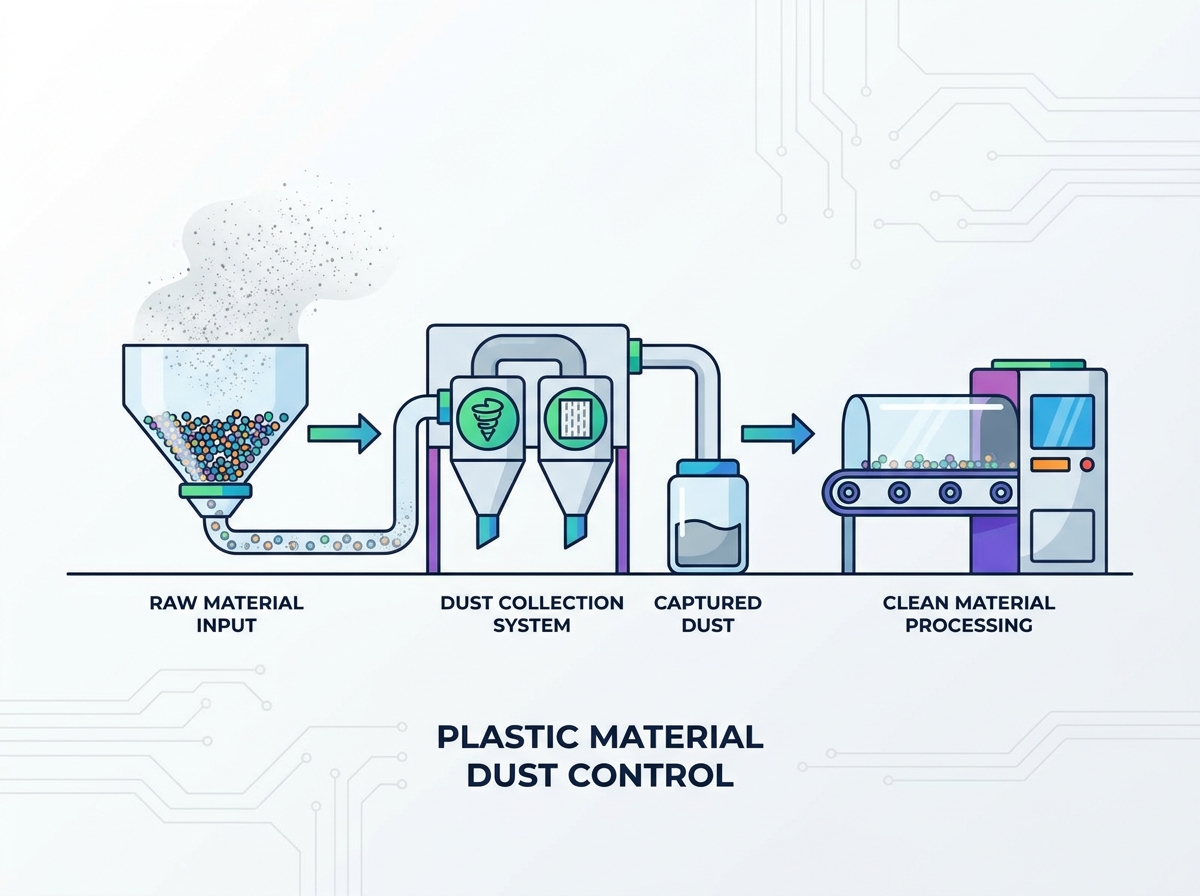
You need a structured methodology to tackle fugitive emissions effectively. Start by auditing all generation points across the facility. Measure air velocities in your pneumatic lines and take dust samples at transition points. This audit provides the baseline data needed to engineer a real solution.
Audit generation points by measuring air velocity and inspecting pipe wear.
Engineer preventative system changes to lower conveying speeds.
Contain fugitive emissions using physical barriers and closed-loop designs.
Apply targeted extraction to capture the unavoidable fines that still escape.
Engineer preventative system changes first. Reduce conveying velocities, fix poor pipe geometry, and upgrade rotary valves before you even consider adding dust collectors. Prevention always costs less than extraction. Once you optimize the system, contain any remaining fugitive emissions using physical barriers and closed-loop designs. Finally, apply targeted extraction to capture the unavoidable fines that still escape.
Evaluate shifting from dilute-phase to dense-phase pneumatic conveying. Dilute-phase systems suspend material in a high-velocity airstream. This method guarantees severe impact damage and high friction. Dense-phase systems operate differently. They push material in slow, high-pressure slugs. This drastically reduces velocity, particle impact, and the resulting dust generation. While dense-phase requires heavier piping and higher pressure air compressors, the reduction in material degradation is substantial.
Use stepped pipeline designs for long conveying distances. As compressed air travels down a pipe, pressure drops and the air expands. This expansion causes the air—and the pellets it carries—to accelerate rapidly toward the end of the line. Stepping the pipe diameter to a larger size accommodates this expanding air. This maintains a constant air velocity and prevents late-stage velocity spikes that shatter pellets. A line that starts at 3 inches might need to step up to 4 inches halfway to the destination to keep the velocity profile flat.
Closed-loop systems keep dust exactly where it originates. Proper engineering ensures transition points remain fully sealed against ambient air. You must evaluate the mechanical tolerances of your equipment. Worn seals and degraded gaskets provide easy escape routes for pressurized polymer fines.
Specialized rotary valves and double-dump valves maintain pressure boundaries between different system components. Double-dump valves use two alternating flaps to drop material while keeping the air seal intact. They prevent pressurized dust from escaping into ambient air much more effectively than standard rotary airlocks. Engineered seals on mixers and loss-in-weight feeders stop fine powders from leaking during continuous operation.
Capture dust right at the point of release. Engineered source capture solutions outperform ambient air filtration by grabbing fines before they spread across the room. Ambient filtration simply cleans the air after the facility is already contaminated, which fails to protect workers from immediate exposure.
Mixing and blending operations require careful management of displaced air. When you load a vessel, the air inside must exit rapidly. Use properly sized localized hoods over these openings. Establish baseline capture velocities specific to the weight and aerodynamic behavior of plastic particulates. Polymer dust requires specific airflow volumes to overcome ambient drafts and pull the material into the ductwork. A capture velocity of 200 to 300 feet per minute at the hood face is typically required to control airborne plastic fines effectively.
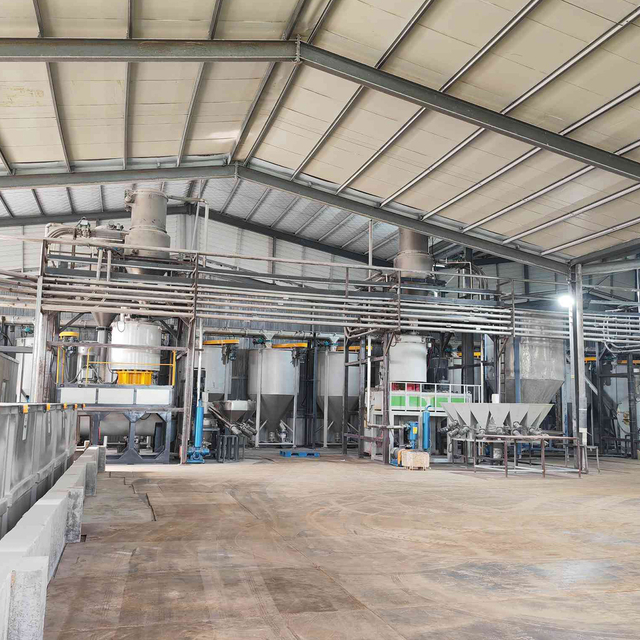
Inline de-dusters separate fines from virgin material before processing. Installing these units directly above the extruder feed throat prevents dust from entering the barrel. This improves product quality and reduces the frequency of screen changes. By removing the dust right before melting, you eliminate the risk of burnt fines causing black specks in the final extruded product.
Counter-flow air wash systems blow air upward through a falling stream of pellets. The heavy pellets drop through the airstream, while the lighter dust and angel hair get carried away into a separate collection unit. You must precisely tune the airflow to match the bulk density of the specific resin. If the air velocity is too high, you will pull good pellets into the dust collector. If it is too low, the dust remains in the material stream.
Compare these pneumatic systems against mechanical screening. Mechanical screens vibrate to separate fines, but they often struggle with statically charged plastic dust that blinds the screen mesh. Air wash systems generally offer a smaller footprint, handle static better, and provide easier integration into existing pneumatic lines.
Surface treatments change how pellets interact with pipe walls. Shot-peening creates a rough, dimpled interior surface. This reduces the surface contact area between the pellet and the pipe. Less contact area means less friction, preventing the localized melting that causes streamer formation. Grooved piping offers similar benefits by forcing the pellets to ride on a cushion of air.
Replace standard sweeping elbows to minimize impact degradation. Blinded T-bends trap a pocket of pellets at the turn. Incoming material impacts against this trapped pocket of plastic rather than the hard metal wall. This significantly reduces shattering. Specialized deflection elbows manage directional friction effectively by changing the impact angle and slowing the material down gently.
Piping Deflection and Elbow Comparison
Component Type | Mechanism of Action | Primary Benefit | System Impact |
|---|---|---|---|
Standard Sweeping Elbow | Direct sliding contact along the outer radius. | Low pressure drop. | High friction, generates angel hair. |
Blinded T-Bend | Traps material to create a plastic-on-plastic impact zone. | Eliminates wall friction at the turn. | Increases system pressure drop significantly. |
Deflection Elbow | Uses a specialized geometry to alter the impact angle. | Reduces shattering without trapping material. | Moderate pressure drop, highly effective for fragile regrind. |
Shot-Peened Piping | Dimpled surface reduces contact area. | Prevents localized melting and streamers. | Requires specialized manufacturing, higher initial cost. |
Filter media selection is critical for plastic fines. Many polymers are sticky, statically charged, or thermally sensitive. Standard polyester felt filters blind quickly when handling these materials. The dust embeds deep into the fabric and refuses to release during cleaning cycles. Once a filter blinds, the pressure drop across the collector spikes, and the system loses suction at the capture hoods.
PTFE membrane filters work exceptionally well for polymer applications. The slick Teflon coating prevents sticky dust from penetrating the media. The dust forms a cake on the surface and releases easily during the pulse-jet cleaning cycle. Evaluate your pulse-jet cleaning mechanisms carefully. Ensure the air-to-cloth ratio matches the demands of continuous operations. A lower air-to-cloth ratio prevents the dust from being forced through the PTFE membrane under heavy loads. For plastic dust, an air-to-cloth ratio of 2:1 or 3:1 is standard to maintain long filter life.
Compliance with NFPA 652 is mandatory for facilities handling polymer dusts. You must conduct a formal Dust Hazard Analysis (DHA) for your entire operation. The DHA identifies every point where combustible dust generates, accumulates, or disperses. OSHA actively cites facilities that fail to perform and document this analysis. You cannot ignore accumulated dust on rafters or cable trays; these are prime locations for secondary explosions.
Understand the Kst (deflagration index) and Pmax (maximum explosion pressure) values of your specific plastic powders. You must send dust samples to a certified lab for explosibility testing. These metrics define the explosive power of the dust. A high Kst value indicates a fast-burning, violent explosion. Polyethylene and polypropylene dusts often exhibit Kst values that place them firmly in the St 1 or St 2 combustible dust hazard classes.
These values dictate your entire system design. They determine the structural reinforcement required for your dust collectors and the exact sizing of your explosion protection equipment. Guessing these values leads to catastrophic equipment failure during a deflagration event.
Dust collection networks require robust explosion protection. When a primary explosion occurs inside a dust collector, the pressure wave travels back through the ductwork. This wave kicks up settled dust in the facility, fueling a secondary deflagration. Secondary deflagrations often cause the most catastrophic structural damage and loss of life.
Evaluate the necessity of explosion venting. Vents rupture at a specific pressure, safely directing the fireball and pressure wave outside the building. You must route these vents to a safe area where personnel do not congregate. If the collector is located indoors, you must use flameless venting devices that quench the fireball before it enters the workspace.
Chemical suppression systems extinguish flames in milliseconds. Optical sensors detect the initial spark and trigger pressurized canisters of suppressant. Mechanical isolation valves slam shut to prevent explosions from traveling back through the ductwork. You must install these isolation devices on all inlet ducts connected to a combustible dust collector.

Analyze the capital expenditure and downtime trade-offs. Installing inline de-dusters and specialized elbows on existing lines offers a quick upgrade path. This approach requires minimal downtime and provides immediate reductions in angel hair and fines. However, if your conveying velocities remain fundamentally too high, retrofits only treat the symptoms. You will still generate dust; you are just getting better at catching it.
Upgrading the entire pneumatic blower package to dense-phase requires significant investment. You must replace blowers, piping, and controls. This causes extended facility downtime. Yet, this complete redesign permanently solves the root cause of material degradation. You must weigh the immediate relief of retrofits against the permanent resolution of a system overhaul.
Generic bulk-handling advice often suggests adding water to increase particle size and cohesiveness. This works well for coal or aggregate, but this approach completely fails in plastics. Most polymer resins require strict drying before extrusion to maintain their structural integrity.
Polymers like PET, Nylon, and Polycarbonate are highly hygroscopic. They absorb moisture from the air. Adding water to suppress dust causes severe extrusion defects, including splay, bubbling, and loss of tensile strength. The chemistry of hydrolysis destroys the polymer chains during melting. Therefore, dry, mechanical, and pneumatic solutions remain mandatory for plastic facilities.
Calculate the hidden costs of your current setup. Track filter replacement cycles, rotary valve wear, and the compressed air usage required for pulse-jet systems. Worn rotary valves leak air, reducing conveying efficiency and increasing blower energy consumption. Cleaning angel hair out of diverter valves consumes massive amounts of maintenance labor. Every hour spent unclogging a feed throat is an hour of lost production.
Establish clear success criteria for your return on investment. Track the volume of recovered material that you can reintroduce into the process. Monitor the reduction in scrap rates caused by dust-induced extrusion defects. Factor in the lowered housekeeping labor and the mitigation of severe safety liabilities. A properly engineered system pays for itself by keeping valuable resin in the process and out of the trash.
Successful mitigation prioritizes a systematic approach. You must manage conveying velocity and piping geometry first to stop degradation at the source. Only after optimizing the system should you apply targeted, point-of-release extraction to capture the remaining fines. Avoid generic bulk-handling advice and focus strictly on dry, pneumatic solutions tailored to polymer behavior.
Decision-makers must audit their current conveying velocities and conduct a formal Dust Hazard Analysis before purchasing any extraction equipment. Buying a dust collector without understanding your Kst values or velocity profiles wastes capital and leaves your facility at risk.
For plastic processors looking to improve material conveying efficiency and reduce dust generation at the source, Zhangjiagang Yifan Machinery Co., Ltd. integrates R&D, manufacturing, sales, and service, with a focus on automatic mixing and feeding systems and intelligent material conveying equipment. With 20 years of industry experience, Yifan Machinery offers solutions including centralized feeding systems, pneumatic conveying systems, high-speed mixers, weighing and metering equipment, providing practical support for more efficient and controlled material handling in plastic processing facilities.
Take these next steps to secure your facility:
Partner with a bulk material handling engineer to perform material explosibility and flow testing.
Conduct system flow modeling to identify pressure drops and velocity spikes in your pneumatic lines.
Specify custom filtration media and isolation equipment based on your exact resin characteristics.
Upgrade elbows and apply surface treatments to piping in all high-impact transition zones.
A: High conveying velocities and friction cause pellets to slide against smooth pipe walls. This friction generates intense heat, leading to localized melting. The melted polymer smears along the pipe interior, forming long, thin strands known as angel hair and streamers that eventually break loose and clog the system.
A: You use inline elutriators, aspirators, or counter-flow air wash systems. These devices force a controlled volume of air upward through a falling stream of pellets. The heavier pellets drop through the airstream, while the lighter dust and fines are carried away into a separate collection unit.
A: Yes, most polymer fines and powders are highly combustible. They pose severe deflagration risks when suspended in air at specific concentrations. Handling them requires strict compliance with OSHA and NFPA standards, including proper hazard analysis, explosion venting, and mechanical isolation.
A: No. While moisture increases cohesiveness in aggregates, it is detrimental to plastic processing. Many resins are hygroscopic and require strict drying. Adding water causes severe extrusion defects like splay and hydrolysis, necessitating dry, mechanical, and pneumatic dust control solutions.
A: Shot-peened interior surfaces and specialized deflection elbows work best. Shot-peening creates a dimpled surface that reduces sliding friction and prevents melting. Blinded T-bends and deflection elbows allow pellets to impact against themselves rather than the metal wall, minimizing material shattering.
A: Dilute-phase suspends material in a high-velocity airstream, causing severe impact damage against pipe walls. Dense-phase moves material in slow, high-pressure slugs. This low-velocity movement drastically reduces particle impact, friction, and the resulting dust generation.
A: You capture the displaced air exactly at the point of release. As material enters the vessel, equal volumes of air must escape. Using localized exhaust hoods over vessel openings and engineering proper capture velocities prevents fines from entering the ambient environment.


