


Views: 0 Author: Site Editor Publish Time: 2026-09-29 Origin: Site


In high-volume, continuous plastic extrusion, material handling inefficiencies directly degrade product quality and cap overall plant throughput. Inconsistent feed rates, resin contamination, and manual loading bottlenecks disrupt the delicate balance required for stable extrusion profiles. Decentralized or manual feeding methods create hidden operational costs. You lose valuable floor space, increase labor requirements, spill material, underutilize regrind, and lose the ability to track resin consumption per line accurately.
Transitioning to a centralized feeding system for extrusion eliminates these variables. It automates the continuous flow of raw materials from bulk storage directly to the extruder throat. This removes human error from the material delivery equation. Extruders receive a constant, perfectly proportioned supply of virgin resin, regrind, and additives. This guide provides a technical framework for evaluating system architecture, assessing integration risks, and modeling the return on investment for facility-wide implementation.
Continuous Throughput vs. Accuracy: A properly sized centralized feeding system must balance bulk conveying capacity with the precise, uninterrupted dosing requirements of individual extrusion lines, often requiring integration with gravimetric blenders and continuous loss-in-weight feeders.
Material Integrity & Regrind: Evaluating conveying velocities and pipe routing is critical to prevent resin degradation, angel hair formation, and dust generation, particularly when handling a mix of virgin pellets and varying bulk-density regrind.
Scalability, Redundancy, & Control: Modern systems require centralized PLC/SCADA integration for real-time traceability, predictive maintenance, and high-availability architectures (e.g., standby pumps) to prevent multi-line shutdowns.
ROI Timeline: Justification for capital expenditure (CapEx) typically relies on quantifying operational expenditure (OpEx) reductions in labor, material waste, energy consumption, and maximized regrind recovery.
Table of Contents
Scaling an extrusion facility eventually exposes the hard limitations of machine-side material loading. Recognizing the operational indicators of a failing decentralized system is the first step toward automation. Frequent extruder starvation is a primary symptom. Operators manually loading hoppers rarely keep pace with high-speed lines. The extruder runs dry, causing immediate line shutdowns, massive scrap generation, and lengthy restart procedures. High scrap rates also stem from mix inconsistencies. Manual blending of virgin resin, colorants, and regrind often results in uneven distribution, leading to color variations and dimensional instability in the final extruded profile or film.
Excessive forklift traffic on the production floor presents another severe bottleneck. Moving gaylords and pallets between storage areas and individual extruders creates safety hazards and consumes valuable manufacturing space. A facility struggling to keep up with high-output lines while managing constant material spills and forklift congestion requires a structural change in material handling. The hidden costs of forklift maintenance, damaged gaylords, and swept-up resin pellets quickly erode profit margins.
Establishing baseline metrics defines success for the system upgrade. Target pounds-per-hour (PPH) throughput must account for current production rates and future capacity expansions. Acceptable variance in material dosing should be clearly defined to ensure product consistency. Maximum allowable downtime during system cutover dictates the installation strategy, requiring phased implementation to keep critical lines running. Targeted regrind utilization percentages must be established to measure material savings accurately.
Before designing the system, a thorough facility readiness assessment is mandatory. Engineers must evaluate the physical constraints of the plant:
Vertical Clearance: Evaluate available ceiling height for silos and surge bins. Gravity drives material flow out of storage, and adequate vertical clearance prevents bridging and rat-holing in storage vessels.
Structural Integrity: Verify structural support for piping manifolds. Routing hundreds of feet of stainless steel tubing, along with the weight of the conveyed material, requires robust ceiling trusses.
Utility Capacity: Confirm the facility possesses adequate utility supply. This includes clean, dry compressed air for valve actuation and sufficient three-phase power to drive industrial vacuum pumps and blowers.
Floor Layout: Map out the current footprint of gaylords and machine-side loaders to calculate the exact square footage that will be reclaimed post-installation.
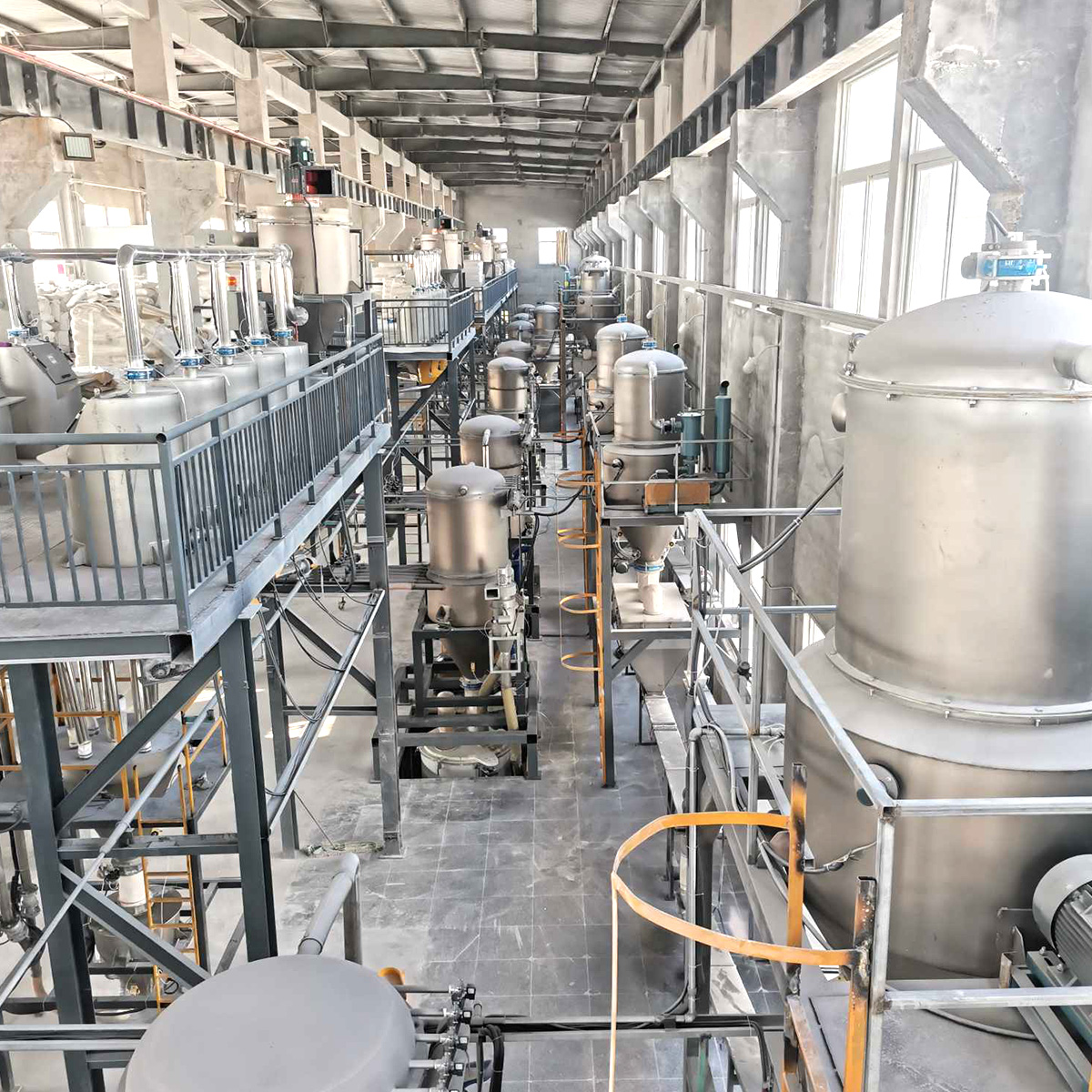
Designing a robust material handling infrastructure requires selecting the right combination of storage, conveying, and control components. The architecture must support the specific resins processed while allowing flexibility for future material changes. A poorly designed architecture leads to frequent blockages and material degradation.
Bulk storage solutions vary based on material volume and facility constraints. Outdoor silos offer the highest capacity for fast-moving commodity resins, freeing up indoor floor space and allowing for bulk tanker deliveries. Indoor day bins provide intermediate storage for specialty resins or materials requiring climate control. Gaylord tilters automate the unloading of boxed materials, ensuring complete evacuation without manual scooping. The distribution manifold acts as the central nervous system of the operation. Automated material selection stations route specific resins to designated extrusion lines. These manifolds utilize quick-disconnect camlock fittings or automated diverter valves to prevent cross-contamination when switching materials between lines.
Selecting the appropriate conveying method depends on distance, throughput, and material characteristics. Each mechanism offers distinct advantages for specific extrusion environments. Matching the blower type and conveying phase to the resin prevents material fracturing and system wear.
Conveying Method | Operating Principle | Best Use Cases | Key Advantages |
|---|---|---|---|
Vacuum Conveying (Negative Pressure) | Draws material through pipes using a vacuum pump located at the destination. | Multiple sources to a single destination; short to medium distances. | Clean operation, inward leaks prevent dust escape, gentle on materials. |
Positive Pressure Conveying | Pushes material through pipes using a blower located at the source. | Single source to multiple destinations; high capacity, long distances. | High throughput, efficient for filling multiple silos or large day bins. |
Dense Phase | Moves material in slugs at low velocity and high pressure. | Fragile, highly abrasive, or blended materials prone to separation. | Prevents pellet degradation, reduces pipe wear, maintains blend integrity. |
Dilute Phase | Suspends material in a high-velocity air stream at low pressure. | Standard plastic pellets, non-abrasive materials, continuous high-volume feeding. | Cost-effective, simple design, ideal for most standard extrusion applications. |
Maximizing regrind utilization directly improves manufacturing margins. A Centralized Feeding System integrates edge trim and scrap recovery directly into the material flow. Proportioning valves located at the receiver alternate between drawing virgin pellets and regrind. Surge bins equipped with mechanical agitators prevent light regrind fluff from bridging. Maintaining a consistent bulk density mix at the extruder throat ensures stable screw recovery times and uniform melt pressure. If regrind is introduced inconsistently, the extruder experiences surging, which alters the dimensions of the final product.
Continuous extrusion lines cannot tolerate material starvation. High-availability architectures require built-in redundancy. Standby vacuum pumps must be integrated into the system, configured to automatically take over if the primary pump fails. Automatic switchover valves and manifold bypasses ensure that a single component failure, such as a jammed diverter or a blown fuse, does not cause catastrophic multi-line starvation. Redundancy transforms a potential plant-wide shutdown into a scheduled maintenance task, allowing technicians to repair the primary pump while production continues uninterrupted.
Hygroscopic resins like PET, ABS, and nylon require strict moisture control before extrusion. Centralized feeding systems interface seamlessly with central desiccant dryers. Material is conveyed from bulk storage to the central dryer, then distributed to individual extruders using dry air conveying to prevent moisture regain. At the extruder throat, the system feeds directly into gravimetric blenders. These blenders continuously weigh and dispense multiple ingredients, ensuring precise recipe management and compensating for variations in regrind bulk density. The feeding system must communicate with the blender to ensure the supply hoppers never run empty during a high-throughput run.
Translating hardware specifications into operational stability requires a deep understanding of fluid dynamics, material science, and facility layout. The technical evaluation must prioritize continuous material delivery over peak theoretical capacity.
Extrusion demands a constant, uninterrupted supply of material, contrasting sharply with the cyclical demands of injection molding. Flood feeding requires the hopper above the extruder to remain full, relying on gravity to feed the screw. Starve feeding meters material directly into the screw flights using a loss-in-weight feeder. Receiver sizes and vacuum pump cycles must be calculated to guarantee material presence at the throat under maximum throughput conditions. Undersized receivers cause the pump to cycle too frequently, leading to premature wear on the discharge valves and potential starvation if the conveying distance is long.
Material properties dictate the physical design of the conveying system. Bulk density determines the mass the air stream must support. Particle size and shape—whether uniform pellets, fine powders, or irregular regrind fluff—affect the friction coefficient against the pipe walls. Blower sizing and pipe diameters must be engineered to achieve the optimal conveying velocity. Excessive speed causes pellets to skid along the pipe, generating frictional heat that melts the plastic and creates "angel hair" or streamers. Insufficient speed causes material to drop out of suspension, plugging the lines and requiring manual cleanout.
Efficient plant floor layouts rely on optimized pipe routing. Engineers calculate equivalent pipe lengths to determine the total resistance in the system. Every vertical lift and directional change adds resistance. For example, a standard 90-degree elbow can add the equivalent of 20 feet of straight pipe resistance. Using long-radius sweeps instead of standard elbows minimizes pressure drops and reduces material degradation. Proper routing keeps piping close to the ceiling, preserving valuable floor space for secondary operations, packaging equipment, and forklift movement.
Conveying generates dust through material friction. Effective filtration at the receiver and pump levels protects equipment and maintains a clean facility. Central dust collectors and cyclone separators remove fines from the air stream before they reach the vacuum pump, preventing premature bearing failure. Handling certain plastic powders or fine regrind introduces combustible dust hazards. System design must strictly adhere to NFPA and ATEX standards. This includes grounding all piping to dissipate static electricity, installing explosion isolation valves, and utilizing explosion-vented dust collectors to maintain facility safety.
Modern material handling relies heavily on intelligent control systems. Hardware automation provides the physical movement, but software integration delivers process visibility and operational control.
Centralized control panels utilize Programmable Logic Controllers (PLCs) to manage pump cycles, valve actuations, and alarm states. Integrating the feeding system with existing extruder controls requires open communication protocols. OPC UA and Ethernet/IP allow the central system to communicate directly with the extrusion line's PLC. This integration enables the extruder to automatically request material based on screw speed and throughput, rather than relying on localized sensor triggers alone. Operators manage recipes and monitor system health through a centralized Human-Machine Interface (HMI), eliminating the need to walk the floor to check individual loaders.
Unexpected equipment failure disrupts production schedules. Utilizing IoT sensors shifts maintenance from reactive to predictive. Differential pressure sensors installed across filters monitor dust accumulation. As the filter blinds over, the pressure drop increases, triggering an alert for maintenance before the restricted airflow causes conveying failures. Vibration monitoring on vacuum pumps and blowers detects bearing wear or misalignment early. Addressing these anomalies during scheduled downtime prevents catastrophic equipment failure and extruder starvation.
Medical, automotive, and aerospace extrusion applications require rigorous quality documentation. Automated feeding systems support ISO and industry-specific compliance by providing digital traceability. The control system logs lot numbers as material enters the bulk storage. It tracks exact resin consumption per work order, mapping specific material batches to specific extruded rolls or profiles. This historical data proves invaluable for quality audits, allowing manufacturers to quickly isolate and contain suspect products in the event of a material defect.
Frequent material or color changes reduce overall equipment effectiveness (OEE). Software features that automate line clearing streamline this process. When a production run ends, the system automatically purges the conveying lines, drawing all remaining material into the receiver or a dedicated scrap bin. This eliminates the need for operators to manually disconnect and blow out pipes with compressed air. Automated purging reduces the risk of cross-contamination between runs and significantly minimizes changeover times, increasing available production hours.
Investing in automated material handling requires a clear financial justification. The analysis must compare the upfront capital requirements against the recurring operational savings generated by the system.
Initial capital costs include blowers, stainless steel piping, receivers, automated manifolds, and the central control system. These upfront expenses are offset by long-term operational savings. The most immediate reduction is in manual handling labor. Reallocating operators from moving gaylords and climbing ladders to value-added tasks improves overall labor efficiency. Automated systems drastically reduce spilled and wasted resin. Manual scooping and hopper loading inevitably result in pellets on the floor, which must be swept up and scrapped. Centralized conveying eliminates this continuous material loss, directly impacting the bottom line.
Scrap generation is an unavoidable reality in extrusion, particularly during startup and size changes. Accurately and automatically reintroducing this regrind into the production process yields significant material cost savings. A centralized system equipped with proportioning valves ensures that regrind is consumed consistently, reducing the dependency on virgin resin. By maximizing the allowable regrind percentage without compromising product quality, manufacturers directly lower their raw material expenditures. If a facility processes 10,000 pounds of resin daily and increases regrind utilization by just 5%, the annual savings in virgin resin purchases quickly justify the equipment investment.
Evaluating the energy footprint is a core component of the ROI model. Centralized systems offer distinct efficiency advantages over decentralized equipment. Implementing variable frequency drives (VFDs) on central vacuum pumps allows the motor speed to adjust based on real-time conveying demand, rather than running at full speed continuously. Centralized drying systems also provide energy gains. A single, large-capacity desiccant dryer operating at steady state consumes less energy per pound of processed resin than multiple smaller, machine-side dryers constantly cycling on and off.
Initiate a comprehensive facility audit to map current material flow, noting distances, vertical lifts, and available ceiling space.
Calculate current scrap rates and manual labor costs associated with material handling to establish a firm ROI baseline.
Request proof-of-concept testing from equipment vendors, specifically for difficult-to-convey resins, powders, and light regrind fluff.
Prioritize system designs that incorporate non-proprietary control systems and robust redundancy planning for critical components.
A: Conveying distances depend on the material and system type. Vacuum systems typically handle distances up to 300-500 feet efficiently. For longer runs, positive pressure systems or dense phase conveying can move materials over 1,000 feet. Equivalent pipe length, including vertical lifts and sweeps, dictates the actual maximum distance.
A: Hygroscopic materials are dried in a central desiccant dryer before conveying. To prevent moisture regain during transport, the system uses closed-loop dry air conveying. The conveying air is drawn from the dryer's return air circuit, ensuring the pellets remain exposed only to low-dew-point air until they reach the extruder.
A: Yes, but it requires specific engineering. Powders require different filtration, specialized receiver discharge valves to prevent bridging, and precise velocity control. Often, separate conveying lines or dense phase systems are used for powders to prevent cross-contamination and manage dust effectively.
A: Regrind is typically collected in a surge bin and introduced into the main material flow using proportioning valves at the receiver. These valves alternate between virgin material and regrind based on a preset ratio, ensuring a consistent mix is delivered directly to the extruder throat or blender.
A: Properly designed systems include redundancy. If the primary vacuum pump fails, the PLC automatically detects the pressure drop and switches operation to a standby pump. This automatic switchover prevents material starvation and keeps the extrusion lines running without interruption.
A: Centralized manifolds use automated diverter valves or quick-disconnect fittings to route specific materials to specific lines. Automated purging software clears the entire line back to the source or into a scrap bin before a new material is introduced, ensuring the pipe is completely empty before the changeover.


